
- obsidian
- second-brain
- yapay-zeka
- pkm
- verimlilik
- not-alma
- dijital-ikiz
Building a Digital Copy of My Brain with Obsidian
How I turned Obsidian from a note-taking app into a personal second brain, fed by Slack messages, emails, and meeting summaries.
Watch on Instagram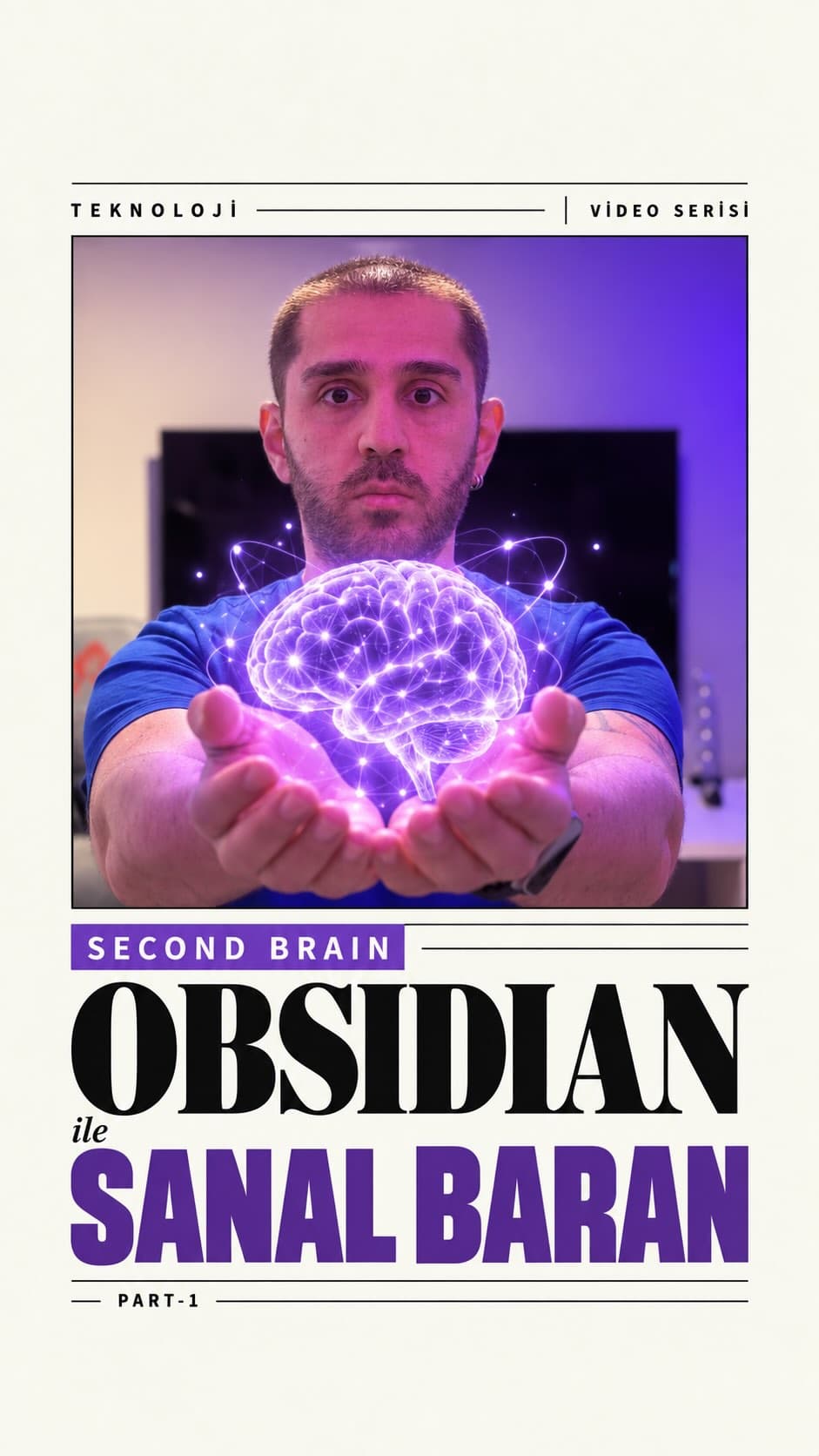
I was planning to make a straightforward introduction to Obsidian. Then a question stopped me: if this app is powerful enough to hold everything, what happens if I put everything I know into it? Could I stop spending energy trying to remember things? And more importantly, could an AI that knows everything I know make connections that I cannot?
Those questions became the "Baran's Second Brain" project.
Why Not Just Use It as a Note-Taking App?
Obsidian is already a complex and capable tool. Using it only as a notebook felt like a waste. My real goal was to turn it into a living system — a channel copy of my brain that stores knowledge and actively links it together.
To design the structure, I spent roughly an hour and a half talking with Claude. I described my life, how I work, and what I wanted from this project. From that conversation, Claude proposed a folder structure of about ten categories. I created a folder on my desktop called "Baran's Second Brain" and started building on that skeleton.
How I Feed the System
An empty structure is worthless. The real challenge is keeping it filled automatically. I asked myself: where do I communicate the most?
Three channels emerged:
- Slack: My daily messages are automatically synced to Obsidian.
- Email: Incoming and outgoing emails are imported into the system.
- Meetings: A Whisper-based tool I introduced previously now includes a note-taking feature. It joins meetings, records everyone's contributions, generates a summary, and drops that summary directly into my Meetings folder in Obsidian. Every meeting is logged by date and time, with a record of who said what.
Connecting these three channels was the moment the Second Brain genuinely started to grow.
The Graph Grows as Connections Multiply
Obsidian's graph view was completely empty at the start. As information flowed in, notes began linking to each other. Looking at the graph now, I can see who connects to whom and through which topics. The deeper you go, the more detailed the relationships become.
I have only been using this system for five days. Even so, the difference is obvious: finding what was discussed in a past meeting is dramatically easier. I open Obsidian, type something like "I talked with Ahmet about this topic — which meeting was it?" and the system finds it immediately.
The Real Goal: Making Connections I Cannot Make Myself
Everything so far is infrastructure. The actual destination is more ambitious: can an AI that knows everything I know find connections and patterns that I would miss on my own?
We do not yet have neural-link technology like something out of Black Mirror. But with Obsidian and the right integrations, building a working model of how a mind organizes knowledge seems genuinely achievable.
The project is still evolving, and there is a lot more to share. This first part covered the foundation — in the next parts, I will go into how the system deepens over time and what role AI plays in making sense of it all.